Why It Matters
The business risks of deep-sea mining
While scientists and ocean experts point to environmental risks, deep-sea mining carries business risks as well. It could cause disruptions in supply chains, worry investors, harm corporate reputation and create regulatory headaches. This page explains why leading companies are adopting a precautionary position.
- Deep-sea mining poses four categories of business risk: supply chain disruption, investor pressure, regulatory uncertainty and reputational damage.
- Companies that depend on cobalt, nickel, or manganese have viable circular alternatives that significantly reduce supply chain risks.
- Investors are increasingly excluding deep-sea mining from their portfolios.
- Public and investor pressure makes association with deep-sea mining a high reputational risk.
SUPPLY CHAIN
Is deep-sea mining supply chain exposure a real business risk?
Yes. Extraction represents only one part of a much larger supply chain. Many of today’s strategic dependencies would remain, as the processing and refining facilities do not exist yet, and would need the investment in the billions of U.S. dollars and decades to be operationally ready. Companies that depend on cobalt, nickel, or manganese have viable sustainable alternatives. Advocating a pause aligns with investment in circular economy strategies — such as recycling, urban mining, and material efficiency — which reduces demand for new extraction and strengthens supply chain resilience.
UNPREDICTABILITY
Insufficient science to quantify full effects or set safe regulatory thresholds for mining impacts. Risk management is not possible without data.
COST
Economics of deep-sea mining industry rely and describe benefits on unproven hypotheses.
REGULATORY
No regulatory framework means uncertainty regarding compliance with international laws and legal responsibility. 43 countries have already called for a pause.
INVESTORS
Are investors flagging deep-sea mining as a material risk?
Increasingly, yes. Financial markets know how to read risk and a growing number of financial institutions, managing trillions in assets, have signaled their opposition to deep-sea mining. Deep-sea mining is already being screened out by financial institutions and insurers due to environmental, social, regulatory and financial risks. Association with deep-sea mining is becoming a liability.
ECONOMICS
Is there a business case for deep-sea mining?
Not really. The economic case for deep-sea mining remains highly uncertain and relies on overly optimistic assumptions. Commercial scale processing systems for deep-sea minerals do not yet exist. Business models depend heavily on assumptions about future mineral demand, commodity prices and battery technologies. The latter is rapidly evolving, with now more than 55% of electric vehicles using lithium-iron-phosphate batteries, which do not require the minerals found on the seafloor.
REPUTATION
What is the reputational risk of sourcing from the deep sea?
Deep-sea mining carries a reputational risk for companies. Public opposition and investor concerns over impacts on marine ecosystems can damage brand value and deter funding, with major firms already excluding seabed metals from supply chains and distancing from the sector.
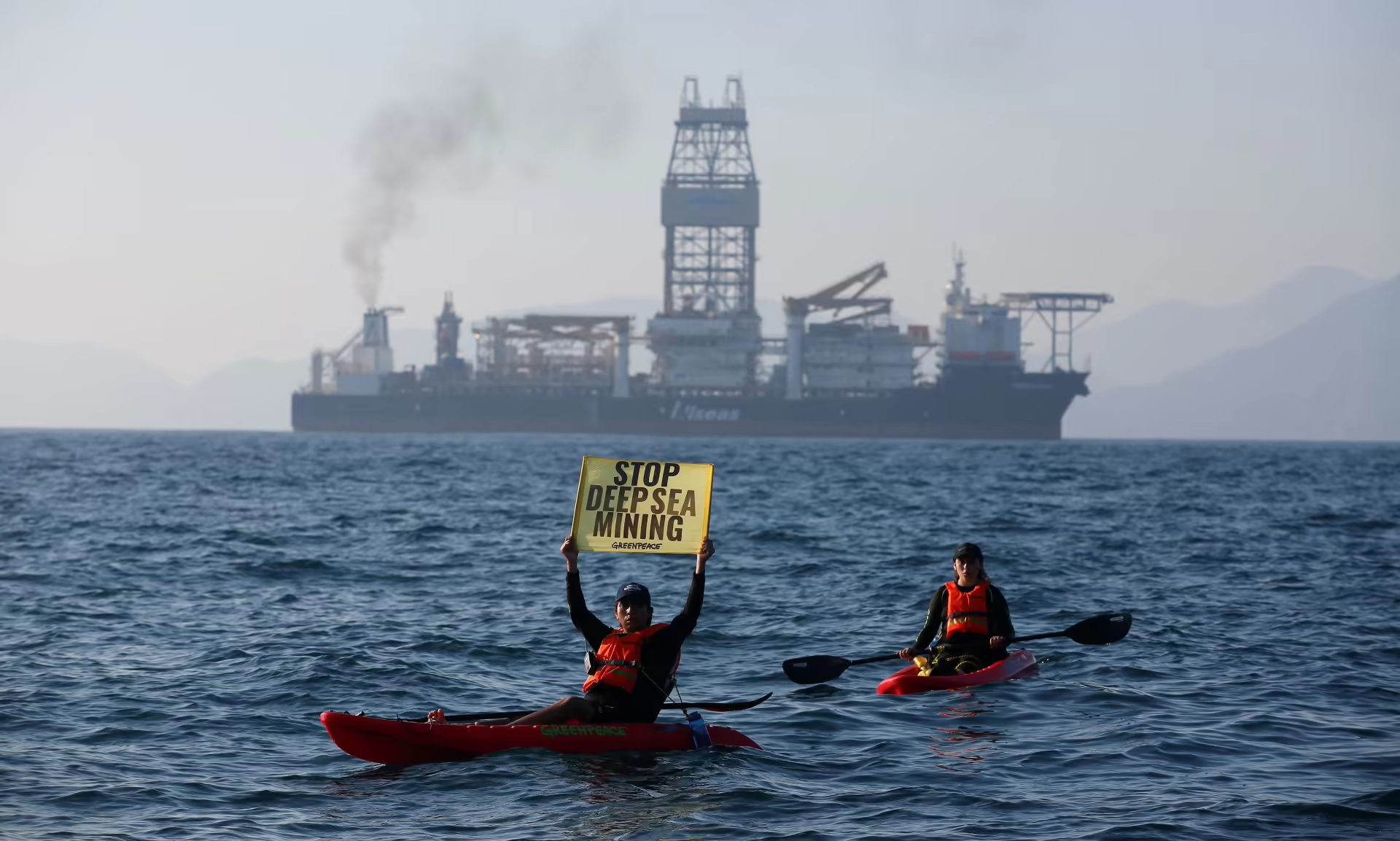
Source: Greenpeace activists protest in front of a deep-sea mining vessel. Photograph: Gustavo Graf Maldonado/Reuters
THERE IS ANOTHER WAY
The risks are avoidable.
Demand for critical minerals is rapidly increasing, but deep-sea extraction is not the only path to meeting it. Four proven alternatives exist.
THE BUSINESS CASE
The question isn't whether deep-sea mining poses risks.
It is whether your company stands on the side of a sustainable, circular economy that delivers benefits for people and nature, or gambles with its own reputation and the health of the ocean. 77 companies have already decided.
EXPLORE THE FULL PICTURE
What is Deep-Sea Mining?
A clear primer on what is extracted, where, and how the ISA regulates it.
Read the guide →Why Companies Have Joined
The case for taking a public position — and what it means in practice.
See the arguments →Alternatives to DSM
Circular economy approaches and responsible terrestrial sourcing strategies.
Explore alternatives →
Join Us
Stand with 77 leading businesses
Add your company's voice to the growing call for a pause on deep-sea mining.
Join now →Read the Statement →