UNDERSTANDING THE ISSUE
What is deep-sea mining?
A primer for business leaders on what minerals would be targeted, where and who regulates deep-sea mining, and why now is the moment to act.
- Deep-sea mining aims to extract minerals and metals such as nickel, cobalt, manganese, and copper from the deep seafloor, seamounts and hydrothermal vents.
- It matters for business because being linked to deep-sea mining creates supply chain exposure to a nascent industry with no commercial track record, unresolved regulatory frameworks, and significant environmental liability.
- 77 companies and financial institutions across 8 sectors have publicly committed to not sourcing minerals from the deep seabed and call on regulators to apply a precautionary pause.
THE BASICS
What exactly is deep-sea mining?
Deep-sea mining is the process of extracting mineral deposits from fragile ecosystems in the deep ocean, which, up to now, have experienced little disturbance from human activities, and are largely unknown to science.
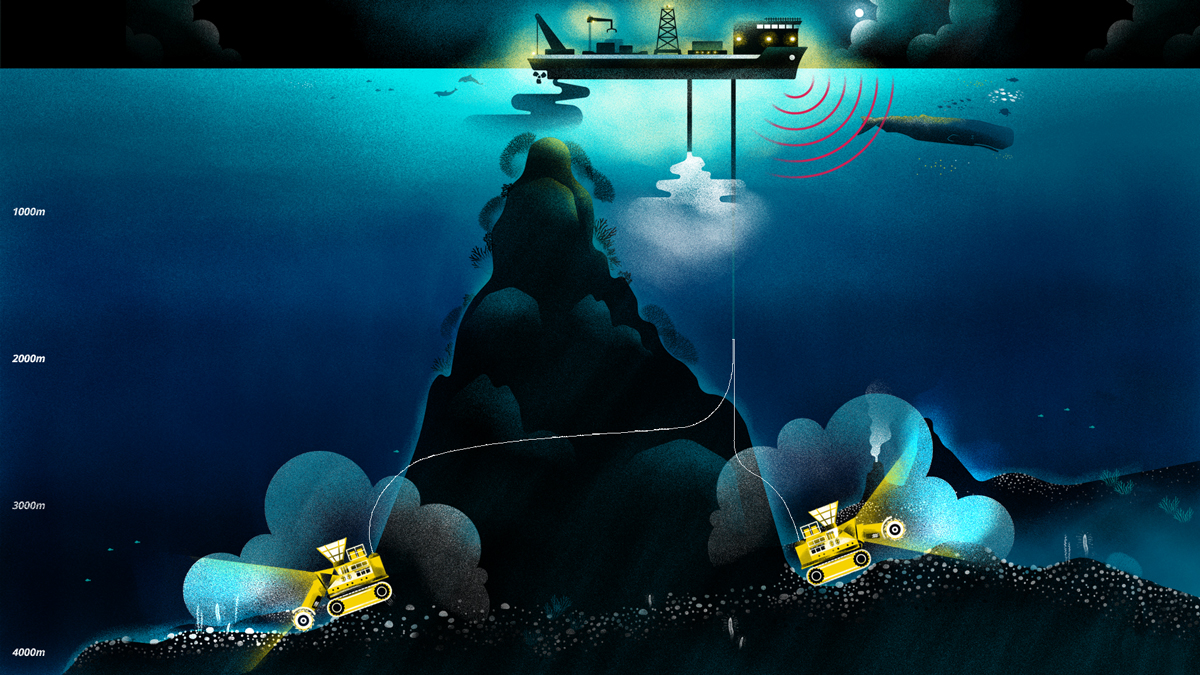
The primary target is polymetallic nodules — potato-sized rocks that contain nickel, cobalt, manganese, and copper. These are found in abyssal plains at depths of 3,500–6,500 metres, generally partially or fully buried in sediment.
But other sensitive ecosystems, including seamounts and hydrothermal vents, are also targeted. Both seamounts and hydrothermal vents are biodiversity hotspots in the deep ocean, home to a wealth of species uniquely adapted to their habitats. These are key areas for future research in marine biology, ocean circulation and climate change.
No commercial deep-sea mining has taken place yet. This is why the current moment is strategically important for companies.
WHERE
Where would deep-sea mining take place?
Deep-sea mining would target three types of mineral deposits, each found in sensitive environments at different depths and requiring different extraction methods. All three types exist in waters beyond national jurisdiction. Mining these environments for minerals would have immediate and irreversible consequences for the organisms that depend on the ecosystems where they are found. All are largely unknown to science and untouched by human activity.
Polymetallic nodules
Polymetallic nodules are found in abyssal plains, generally partially or fully buried in sediment. They are removed by scraping the ocean floor, removing all seafloor organisms, sending the nodules to a vessel on the surface and dumping the remaining sediment back into the ocean. Most planned mining for polymetallic nodules would take place in the Clarion-Clipperton Zone (CCZ) in the central Pacific Ocean.
Cobalt-rich crusts
Cobalt-rich crusts extraction requires cutting, crushing, and removing rock on steep, rugged terrain which is a technological challenge with under-studied consequences.
Polymetallic sulphides
Vent systems precipitate seafloor massive sulphide deposits that are rich in copper, gold, silver, and zinc. The only way to collect these minerals is to destroy the vent. In international waters, hydrothermal vent mining is being considered along Mid-Ocean Ridges, where oceanic plates are spreading apart and conditions are extremely harsh.
REGULATION
Who regulates deep-sea mining in international waters ? The role of the ISA
The International Seabed Authority (ISA) is an international organisation established in 1994 under the United Nations Convention on the Law of the Sea (UNCLOS). The ISA has 172 members (171 member states and the European Union).
The Mandate
The ISA has a dual mandate of ensuring both the effective protection of marine environment and authorizing and overseeing any mineral-related activities occurring on the deep seabed in areas beyond national jurisdiction known as 'the Area.' UNCLOS establishes that the Area and the mineral resources found there are the common heritage of humankind.
The Mining Code
Governments at the ISA are currently negotiating the Mining Code — the regulations that would govern commercial operations. These rules are not yet finalized, and unresolved issues include an agreement on how to share any benefits from deep-sea mining and how to ensure effective protection given the large gaps in scientific knowledge. Business voices can still help shape the outcome by publicly calling for a pause until all outstanding issues are resolved.
The Momentum
Some ISA member states are suggesting to fast-track exploitation regulations despite the lack of agreement. Forty-six states and the scientific community have called for a pause. Deep-sea mining should not be permitted unless and until we have sufficient scientific information and can ensure effective protection of the marine environment.
EXPLORE THE FULL PICTURE
Business Risks
What regulatory, ESG and reputational risks does deep-sea mining create for companies?
Read the analysis →Why Companies Have Joined
The case for taking a public position — and what it means in practice.
See the arguments →Alternatives to DSM
Circular economy approaches and responsible terrestrial sourcing strategies.
Explore alternatives →
Join Us
Stand with 77 leading businesses
Add your company's voice to the growing call for a pause on deep-sea mining.
Join now →Read the Statement →